News | Posted September 15, 2026
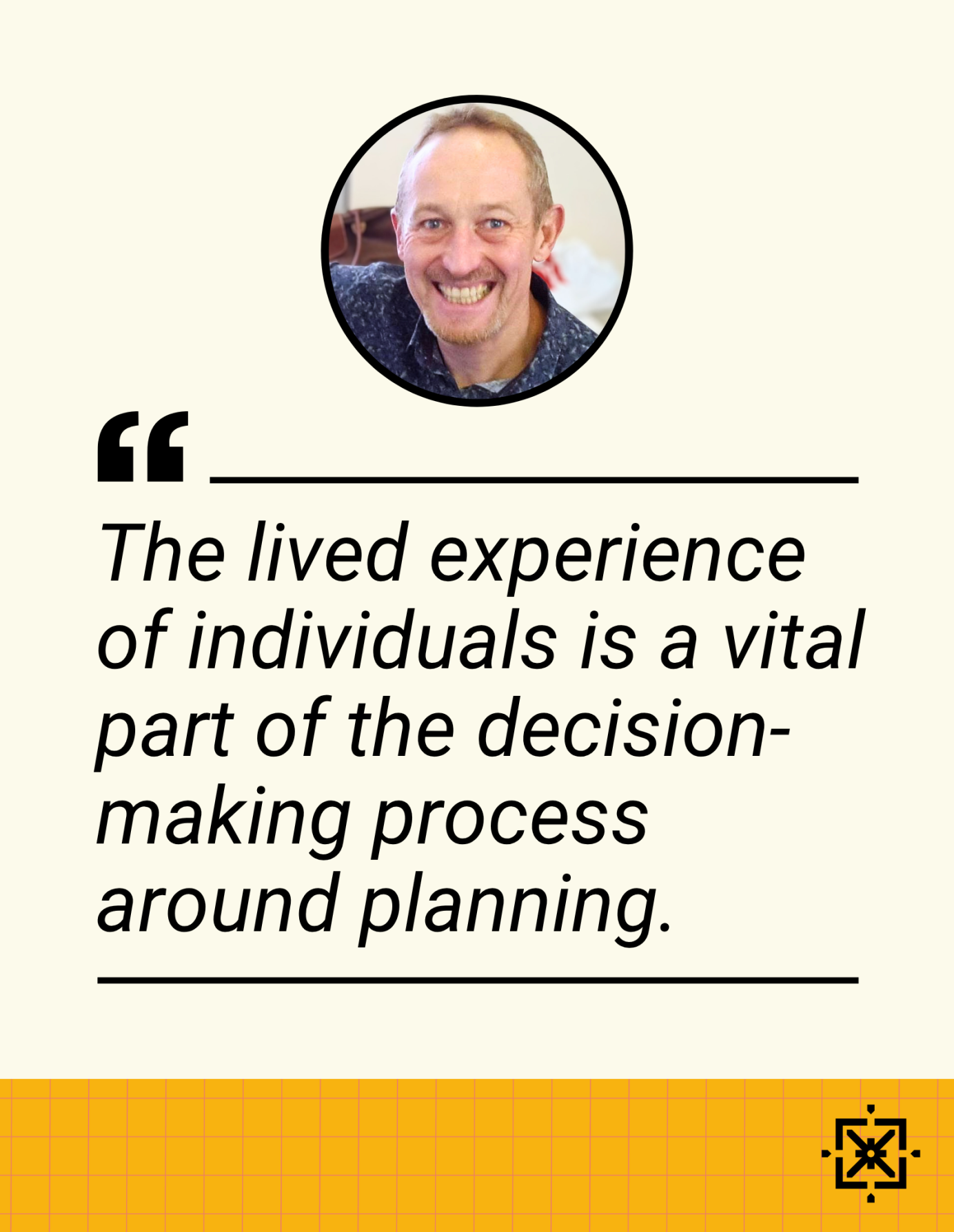
Meet Sam: “The lived experience of individuals is a vital part of the decision-making process around planning.”
Join us in getting to know some of the people at the heart of Planning Aid Scotland, our volunteers!
Join us in getting to know some of the people at the heart of Planning Aid Scotland, our volunteers! In this blog, we meet Sam Whitmore, a volunteer who works in place-based practice at Public Health Scotland. Sam talks about how volunteering with us on various projects over the years has enabled him to explore his profession from different perspectives:
“It’s been a very enjoyable journey, a very enjoyable experience and an exploration of what I do for a living.”
Tell us a bit about yourself
I was born in Suffolk in England in a very rural environment, and I grew up within a farming community.
After I left school, my employment took me to places like Belize in Central America, Ecuador in South America and Bangladesh in Asia – mostly working in overseas aid.
When I returned to Scotland I worked for a series of voluntary sector organisations in Glasgow on areas such as drug rehab and supporting people with epilepsy.
I then found myself at Public Health Scotland. I’ve been working there for the last five years in the place-based practice team.
What do you like to do in your free time?
I see my volunteering with Planning Aid Scotland as a hobby because I enjoy it. I feel I’m valued in what I do and invariably the people I meet are, in the main, lovely people.
My other hobbies have similar ingredients. I have an allotment where I grow fruit and vegetables. I also do beekeeping. I enjoy both tremendously and get to meet lots of wonderful people.
So basically, outside of work I spend time doing things I really enjoy with lovely people (and bees).
How did you get involved with Planning Aid Scotland?
It was a very fortunate coincidence that my work in place-based practice brought me into contact with Planning Aid Scotland. I recognised that it would offer me the opportunity to learn more about planning, which I knew very little about.
It also offered me the opportunity to ‘practise my craft’, by being involved at a community level with place-based practice and getting to use the Place Standard Tool. So really, it was a very selfish act on my part, but I’m thoroughly enjoying the experience.
What has been your favourite experience as a volunteer?
You know, I’ve been thinking about this one. In September 2023, I went to a high school in Dunbar. We used a hybrid Place Standard Tool to work with the young people to identify issues that were important to them. It was the first time I’d actually seen the Place Standard Tool used with young people, and it was used to really good effect. For me, from a professional, from a volunteering, from just an experience – it was memorable and I learned a lot on that particular day.
Any top tips you’ve learnt from volunteering with Planning Aid Scotland?
What I’ve learnt through volunteering with Planning Aid Scotland is the value of listening.
Listening to community members speak with passion, enthusiasm and experience about the places they live and the issues that are important to them. It makes you realise that the lived experience of individuals is a vital part of the decision-making process around planning.
I know what passive and active listening are, but it’s only through working with you guys and having the opportunity to listen to so many community members speak with such passion, that I’ve really appreciated the difference.
My last experience really brought that home. There were 100 people in a room, and the passion was clear. If you fail to listen to that, you’re in danger of missing the whole point of why people live where they live.
You mentioned your last volunteering experience – supporting Balerno Community Council in the development of their Local Place Plan. How did you find it?
I was there because the gentleman who would normally chair these events had a conflict of interest with one of the agenda items and felt unable to perform the role. So I went along to chair the event, with a great deal of help from community members and the people who were there on the day.
Ultimately, it was a very good experience. I got a lot from it, I enjoyed it and most importantly, I felt that the people in the audience recognised that I was an impartial advocate for them and had no hidden agendas. Without their understanding of the impartiality, they wouldn’t trust the service or the process. I was pleased that came across.
What do you find inspiring about planning in Scotland?
There’s a great example of supported living flats in the centre of Alloa. These flats are designed specifically for people living with dementia. People were initially worried that having them in the centre of Alloa would cause issues for the residents and local population.
To everyone’s surprise and glee, it turned out completely differently. It works so well for the people living there and the local community has embraced them. I think everyone has benefited enormously from it.
That is really important for me, because as far as place-based practice is concerned, it often takes a long time to get from public consultation to bricks on the ground, buildings being completed, occupants moving in and then seeing the final result.
To reflect and understand that the process started with a Place Standard Tool exercise and ended with a process where you’ve got 30 or 40 people living in this environment and that the concerns of the local community were shared, explored and dealt with. It’s a huge success from my perspective.
Any fun facts about planning?
I don’t have a fun fact, but I do have a fact that has dawned on me over the course of being a volunteer with Planning Aid Scotland. It’s that urban planning shapes the places that we live, work and play in. It affects our daily lives in ways we might not even realise.
Naturally, being a volunteer with Planning Aid Scotland has helped me make those connections between planning and place-based practice. It’s been a very enjoyable journey, a very enjoyable experience and an exploration of what I do for a living.
Thinking about where I would choose to live, and how I would choose to live, and recognising that planning is the basis of that, it’s about as fun as it gets. If you can provide something where people are at ease with themselves and at ease with their environment – that’s about as much fun as you could ever wish for!
We want to hear from you!
If you’re interested in doing a profile for our blog, please get in touch.