News | Posted September 22, 2026
Cars and planning – a bumpy ride
On World Car Free Day, we look at the impact the motorcar has had on urban planning and how planning priorities related to the car have changed over the years. We also revisit our Sustaining Choices programme to see how active travel plans can help local areas take ownership of their unique challenges and inspire creative, community-led solutions.
Creating a momentum
World Car Free Day is celebrated annually on 22 September and is touted as an opportunity to reduce air pollution. The idea is simple – forgo the car for the day and take alternative transport. It’s a chance to showcase what our urban areas could look, feel and sound like without the car – something that could spark longer-term change.
The impact of going car-free can be significant. In 2015, Paris reported a 40% reduction in exhaust emissions during its first ‘journée sans voiture’, or ‘day without cars’. Since 2016, Paris has held monthly car-free days known as Paris Respire, meaning ‘Paris breathes’, when certain areas are transformed into pedestrian zones.
World Car Free Day now sits within the wider European Mobility Week, which looks at ensuring everyone can access sustainable transport regardless of income, location, gender or ability. This year’s theme looks closely at “intergenerational fairness” recognising that decisions made today affect people of different ages, as well as generations to come.
The other 364 days
While an international day or week can help draw attention to an issue and start a conversation, the longer-term change comes down to planning. In Scotland, the National Transport Strategy 2, published in 2020, prioritises walking, wheeling and cycling over single-occupancy private car use. The National Planning Framework 4 (NPF4), adopted in 2023, continues this focus and has, for the first time, made active travel a main consideration. Policy 13 (Sustainable Transport) requires new developments to be designed around walking, wheeling, cycling and public transport for everyday journeys, aiming to minimise car dominance.
Despite the Scottish Government’s climate change commitment to reducing car kilometres by 20% by 2030 now being seen as unachievable, it’s not all bad news. Progress has been made through other policies aimed at reducing car dependency, including the expansion of free bus travel to under-22s. Other measures to reduce pollution in cities, such as Glasgow’s Low Emission Zone, have also seen success, with recent data showing nitrogen dioxide levels in the city centre have dropped significantly.
So how did we get here?
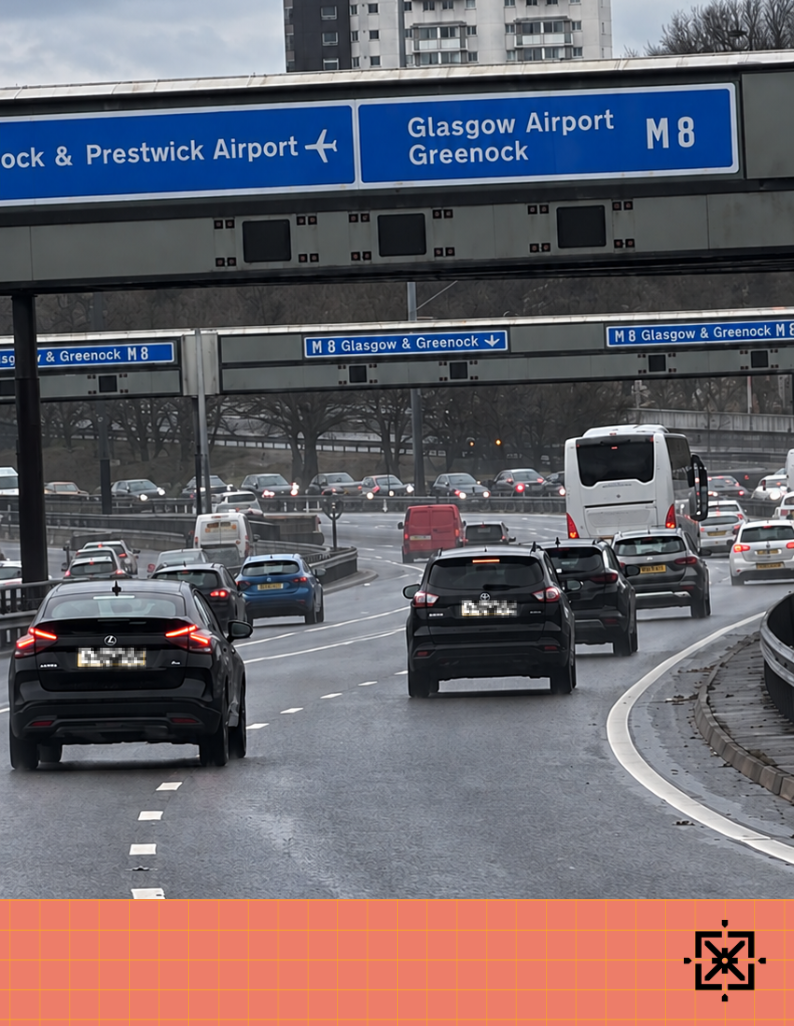
In post-war Britain, the car was a way of life, and our towns and cities were redesigned to accommodate it. The construction of out-of-town shopping centres from the 1980s to the 1990s further solidified our reliance on cars.
But now things are changing. We’re starting to reclaim these spaces from pollution and congestion and make them more pedestrian-friendly. While thinking in the UK began to shift around the 1960s with the publication of Traffic in Towns by a team led by planner Colin Buchanan, growing understanding of the health impact of car exhaust and increased awareness of climate change have accelerated our move away from cars.
Glasgow’s Liveable Neighbourhoods is one example of this shift. The fabric of Glasgow was disrupted significantly by the car, with multiple reports detailing a car-centric vision for the city. Published at the end of 2022, Glasgow’s Liveable Neighbourhoods aims to reduce the city’s dependency on cars and create safer streets that prioritise active travel and public transport.
The impact of the car on town planning can also be seen in the New Towns, such as Cumbernauld, where car ownership was integral to the design, with a deliberate emphasis on separating pedestrians from traffic.
While much of this car-centric construction may seem misguided now, at the time it offered a lifeline to more rural communities, making urban centres more accessible. Love it or hate it, transport infrastructure has created unique issues for the communities living alongside it.
Encouraging active travel
Moving away from the car is also an equality issue – around a quarter of households in Scotland have no access to a car. There’s also a notable divide between car ownership in rural and urban areas, with rural communities often pushed into car ownership due to a lack of alternatives. This is why it’s so important to acknowledge the different situations facing different communities and work with them to find solutions that actually fit.
Over the years, our Sustaining Choices programme has seen remarkable success in collaborating with communities to develop active and sustainable travel action plans, rooted in local knowledge and community action.
Most recently, in 2024–2025, we worked with communities in Ruthrieston, Fa’side, Eskdalemuir and Kelty to develop Local Walking and Wheeling Action Plans, setting out key tasks each community can work towards to encourage active travel.
The resulting reports brought together the views of over 650 people who took part in engagement events and online surveys. They analysed barriers to walking and wheeling in each area and set out suggestions to make active travel easier and more accessible for everyone.
Common issues that came up across the areas included the need for better path maintenance, clearer signposting, accessibility barriers and poor connectivity. Many of these issues are a legacy of decisions that prioritised car use, with footpaths and cycle routes too often treated as an afterthought.
This is why locally-led planning matters. National targets can shift as priorities and technologies change, but a plan rooted in local knowledge and lived community experience lays the groundwork for real change.
What happened next?
Some of the actions that emerged from the plans included improving path surfaces and better maintaining existing routes. Communities also worked on making pathways more accessible and creating new, better-connected and safer routes.
In Fa’side, a new weekly walking group has been established, linked to a community kitchen. Lighting in a local park has been fixed to improve safety, and two paths in Tranent have been upgraded. The community has also held events to promote cycling and is now looking at setting up a walking bus for a local primary school.
In Eskdalemuir, the community wanted to make local walks more interesting by connecting them with the area’s archaeological history. They created a reconstruction of an Iron Age village, where people can see what a settlement from that period might have looked like. Another action emerging from the plan was to promote cycling and hiking in the area. Since publishing the plan, a local cycling group has launched, providing e-bike hire and organising family cycle events and guided rides.
Cars of the future
Electric, autonomous – new technologies can offer solutions to some of the problems cars create, but they also bring their own, sometimes unforeseen issues. Electric cars may help reduce exhaust emissions and support climate change targets, but they come with human rights and other environmental considerations that will need to be addressed. Self-driving cars may also seem like a convenient solution, but they don’t address congestion and may introduce new problems, such as empty vehicles roaming the streets to avoid parking fees.
What the future holds for cars is uncertain, but a blended approach that prioritises sustainable travel will hopefully support the health and wellbeing of future generations while making our urban areas more liveable and prosperous. The main takeaway? Each community is unique, and given Scotland’s varied landscape and diverse population, one solution is unlikely to suit all. It’s important to hear the voices of those most affected by our decisions, ask questions, and keep communities at the heart of the process.
Interested in learning more about active travel plans?
Watch a video about the launch of the Kelty Walking and Wheeling Action Plan